
The daily loop: How NEURA Robotics iterates on industry-leading physical AI

For Jens Buchner, the case for physical AI comes down to a simple observation: almost everything AI has done well so far has happened on a screen, and he thinks that’s about to change.
“Physical AI is applying AI into physical products,” he says. “It’s broader than robotics itself. It can be cars, drones, many objects. But robotics is the end discipline of this realm. A robot is basically the perfect physical AI device.”

NEURA Robotics, a full-stack robotics company based in Metzingen, Germany, recently closed the largest funding round ever raised by a full-stack robotics company, with a target of shipping millions of robots by 2030. Jens Buchner leads the team responsible for the foundation model underneath that ambition: NEURA Robotics’ perception-language-action model, trained and evaluated using Weights & Biases at every stage.
Read on to learn why Jens Buchner believes this is the moment for physical AI, how NEURA Robotics turned a data problem into a physical building solution called the NEURA Gym, and how CoreWeave Software became their indispensable tool of choice for all machine learning work and experiments.
Why NEURA owns the entire robotics stack
Jens Buchner’s case for timing rests on two things converging at once. On the technology side, robotic hardware has had roughly 40 years to mature, and AI capabilities like computer vision have already proven themselves at scale in other domains – surveillance, autonomous driving, the “screen world.” On the demand side, he points to demographics. “Possibly never before in history has the demand for this kind of technology been higher than now,” he says. Aging populations globally are creating structural pressure for automation just to keep those societies functioning.
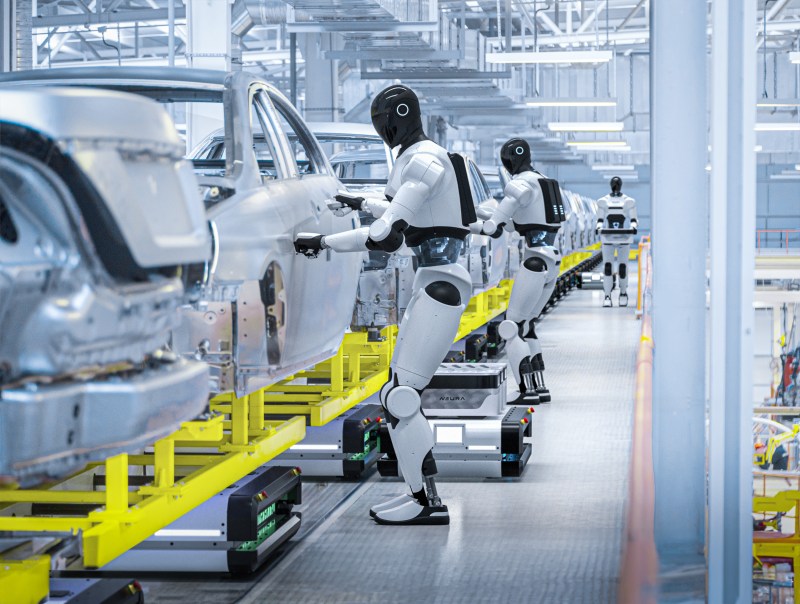
NEURA Robotics’ answer is to own the entire stack—sensors, robots, software, and models, all built in-house. Jens Buchner frames this as a speed requirement. “Robotics right now is in a Cambrian explosion,” he says. “This is a combined iteration on the complete stack—hardware, electronics, AI, and the whole data and infrastructure game. As a fully vertically integrated company, we have the guts to do these iterations fast.” Just as important, he says, is proximity to customers: “It’s very hard to bootstrap AI of that kind without having reflection points in the real application.”
Jens Buchner’s own career path to NEURA Robotics runs through physics and autonomous driving, and from the regional area of Stuttgart, near Metzingen where NEURA Robotics is now headquartered. Buchner also considers this region to be the historic center and condensed talent base of electromechanical engineering and autonomous technology in Europe. His own time in autonomous driving shapes how he thinks about the more challenging problem he has now: “What I learned is that large amounts of data matter but finding the right data matters more—the entropy is the crucial question, not the sheer size of data,” said Jens Buchner.
“Automated driving solves a problem that’s well-posed. Manipulation robotics is different—it’s essentially impossible to anticipate everything a robot needs to do to solve a customer’s problem. The only way to find out is to let it hit the real world.”
Inside the real world of the NEURA Gym
That belief is the fundamental reason for the formation and expansion of the NEURA Gym, facilities are built around roughly 100 “cells,” each housing at least one robot, where partners and customers bring in the real environments and tasks they need solved. The loop runs daily: the robot attempts the task, the team evaluates how it performed, decides what data needs to be collected, runs that collection, trains the model, validates it in simulation, and tests it again on the real robot.
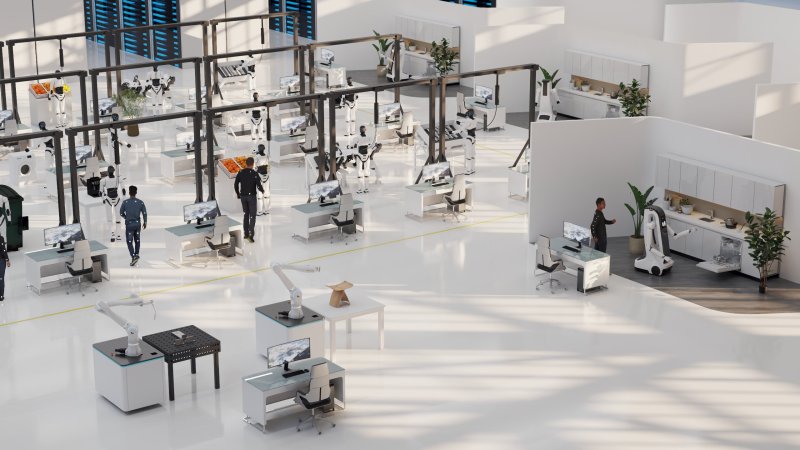
The tasks themselves are typical tasks a worker would perform: the pick-and-place of industrial objects, moving them around, stacking, sorting, and modifying their stage, along with full sequences that chain several of these together, as the core of NEURA’s target market. Private-home applications are in scope too, but industrial use cases are where NEURA is focused first. “Whatever our partners and customers demand,” he says, is effectively the spec: the Gym exists to cover it.
They are now scaling that model well beyond Germany. A 2,300-square-meter Gym with the Technical University of Munich (TUM) is next, with additional sites planned in Hangzhou, Japan, Detroit, California, and several more locations across Europe. For customers, the output of a Gym engagement isn’t just a working robot. They can fine-tune NEURA’s base model and feed the resulting data back into the shared base model, keep a fine-tuned version and its data fully proprietary, or fine-tune a dedicated skill and sell that model back into the broader market.
How CoreWeave fits into the loop
Every stage of that daily cycle runs through W&B Models. Jens Buchner’s team tracks three evaluation stages in the CoreWeave platform: training and validation metrics during base training, simulation testing, and real-world testing on the physical robot, fed in through local tooling. What he values most isn’t any single metric, but being able to see why a result happened, not just whether it happened. “If you just look at the high-level KPI, you might only get a binary answer—am I happy or not happy,” he says. “But if you’re not happy, what do you do? You need fast access to the underlying information.”
Reporting is the other piece he leans on hard, both for the daily Gym cycle and for the larger base-training effort. NEURA Robotics builds W&B Reports that roll up from a high-level KPI down through classes of use cases to individual use cases, all in one place. He’s blunt about what this replaced: “I’ve experienced this before in other teams, where insights were a wild combination of tools—exporting data from your ML ops platform, making a static plot for a PDF, putting it on some wiki page you then have to dig through. A tool like Weights & Biases lets you dig directly into the data generating the results.” He pushes his team to document base-training insights in W&B Models the same way, so findings aren’t lost between people.
NEURA Robotics’ near-term test is scaling the NEURA Gym model globally while proving that its foundation model actually gets better as more skills and more data flow into it, what Jens Buchner calls the paradigm shift robotics hasn’t had yet. “Every time you get an update on your smartphone, you see this in the software world daily,” he says. “Having that happen on a physical product doing real work is something we’ve never really seen before.”
His own bar for what success looks like is clear, and very human in nature. “Seeing a robot work on a task for twenty minutes, get stuck, ask what to do next, or recover on its own–that would be a truly special moment.”
Learn more about NEURA Robotics and how they are delivering the future of intelligent robots.