For more information or if you need help retrieving your data, please contact Weights & Biases Customer Support at support@wandb.com
Physical AI today involves systems that perceive, reason, and act in the physical world through sensors, models, control software, and actuators. Unlike software-only AI systems, its outputs can directly affect real environments. This means evaluation must account for latency, uncertainty, safety, feedback loops, hardware constraints, and physical failure modes.

In the latest article by Satya Nadella, you might have heard: “A frontier without an ecosystem is not stable”. The model is no longer just producing a prediction, score, answer, or recommendation. It becomes part of a larger system loop where cameras, LiDAR, depth sensors, IMUs, controllers, robots, vehicles, and edge devices continuously observe the world, decide what to do next, and act on that decision.
In this article, we will look at what Physical AI means in practice, how it differs from traditional software-only AI, why it matters, training the models, and along the way, we will point out where Weights & Biases fits into this workflow, because tracking experiments.
Most AI systems we interact with today live inside software. A recommendation model ranks a video. A chatbot generates a response. A fraud detection model assigns a risk score. These systems can still cause business or user impact, but their output usually remains digital.
Physical AI is different because the model output can become motion, force, perception, inspection, manipulation, or control. A robotic arm may pick an object from a bin. An autonomous vehicle may brake, turn, or accelerate. A smart camera system may detect unsafe movement inside a warehouse. This means physical AI is not just about model accuracy. Physical AI encompasses the entire operating system surrounding the model. Engineers need to think about perception, state estimation, control latency, safety boundaries, edge runtime constraints, data logging, simulation coverage, and post-deployment monitoring.
The practical stakes are high. The hard part of physical AI is that failures do not stay in a notebook; they occur around moving objects, workers, robot arms, vehicles, and production lines. A small delay can completely change the action, and a wrong prediction can result in a safety stop, a damaged part, a blocked path, or a near miss.
Observability also becomes harder because you are not only watching model drift, you are watching how the system behaves when sensors are noisy, lighting changes, objects move differently, or the environment does something the simulator never showed.
When AI stays within software, mistakes usually stay on a screen, in a dashboard, or within a workflow. A recommendation can be irrelevant, a chatbot can answer poorly, or a classifier can assign the wrong label. With Physical AI, once a model is connected to cameras, sensors, controllers, actuators, or any other IoT devices, the question is no longer just “Was the prediction correct?” It becomes “Did the system act safely, on time, and in the right context?”
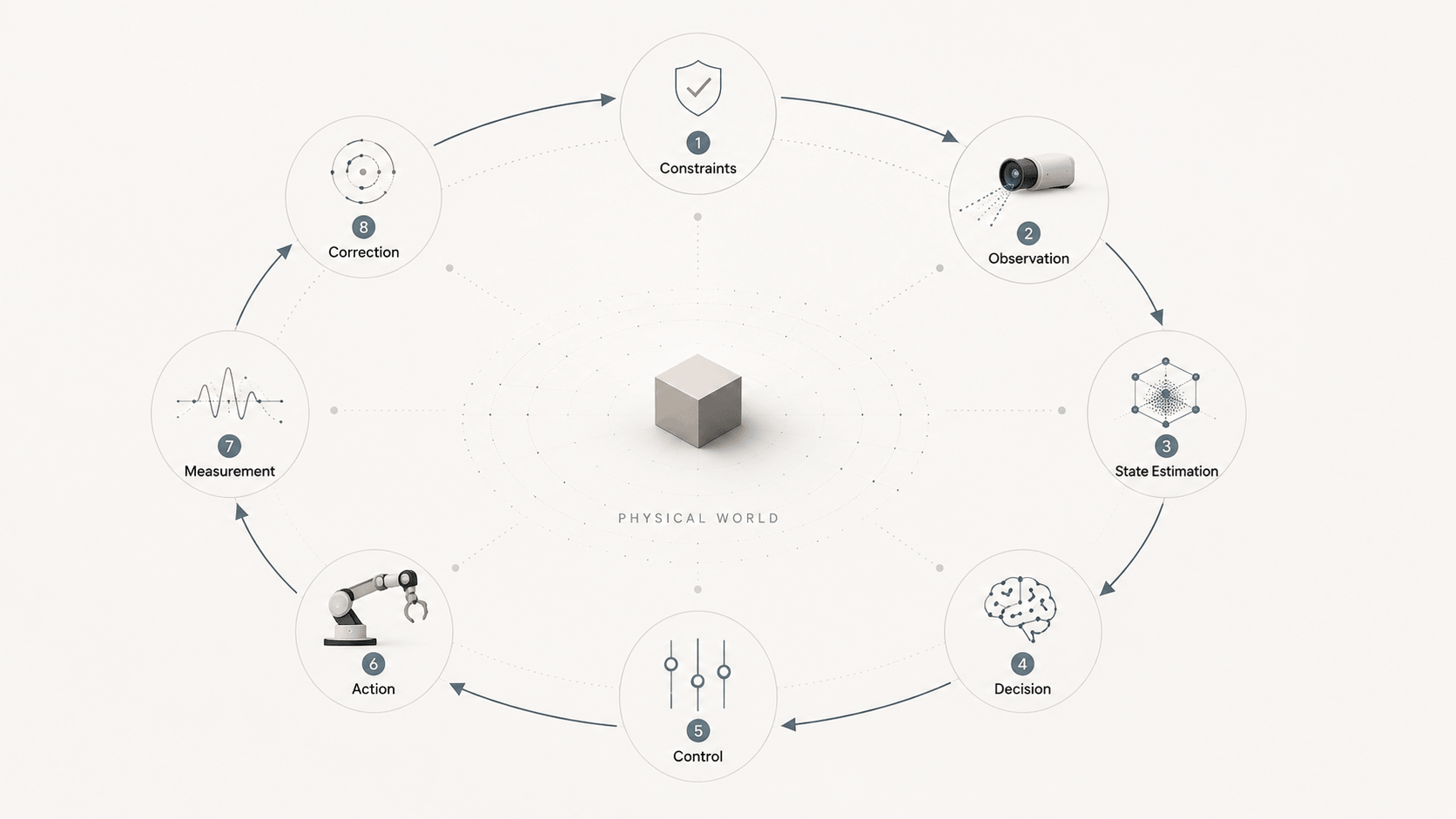
The core difference is that physical AI is usually a closed-loop system. The loop looks like this:
Constraints -> Observation -> state estimation -> decision -> control -> action -> measurement -> correction
A robot observes the world through sensors, builds an estimate of the current state, decides what action to take, and then a controller converts that action into motor commands. The environment changes, the system measures the result, corrects the next action, and the same loop continues until the task is complete or a safety condition stops it.
This closed loop is also why errors behave very differently from a normal machine learning pipeline, because a bad prediction in a recommendation system usually ends with one bad suggestion, but a bad state estimate in a physical system can affect the next planning step, then the next control command, then where the robot actually moves, and then what the sensors see next.
This is why physical AI systems usually need explicit safety layers with constraints such as velocity limits, collision checks, and fallback behaviors, so the system can catch the moment when the loop starts drifting into danger.
Physical autonomy matters because many valuable tasks are not API calls; they occur in aisles, on roads, in operating rooms, in fields, and in factories. Robots and smart spaces need models that can understand geometry, anticipate motion, and act safely when the scene changes.
In practice, this means a team building a Physical AI use case usually maintains two parallel concerns at once. One is the standard ML concern: is the model accurate, does it generalize, is it improving over time? The other is an operational concern that does not have a clean analog in software-only AI: what happens the moment the model is wrong? Does the system fail safely, by stopping or slowing down, or does it fail in a way that compounds the problem?
Teams answer this by layering rule-based safety checks on top of learned components, running extensive scenario testing in simulation before anything touches a real environment, and maintaining a tight feedback loop between field incidents and the next round of training data.
Below you’ll find a table that cleanly illustrates how AI changes when it moves from generating digital outputs to controlling actions in the physical world.
| Dimension | Software only AI | Physical world AI |
|---|---|---|
| Input data | Text, tabular data, clicks, logs | Camera frames, LiDAR point clouds, depth maps, IMU readings, force sensors |
| Output type | A score, a label, generated text, a recommendation | A trajectory, a torque command, a grasp pose, a steering angle |
| Failure mode | Wrong answer, bad recommendation, hallucinated text | Collision, missed grasp, late braking, unstable motion |
| Evaluation | Offline metrics, A/B tests, held out datasets | Simulation benchmarks, real world trials, safety interventions, long tail scenario testing |
| Deployment surface | Cloud servers, browsers, APIs | Edge compute, embedded controllers, real time operating systems |
Let’s talk about the core system loop in technical depth.
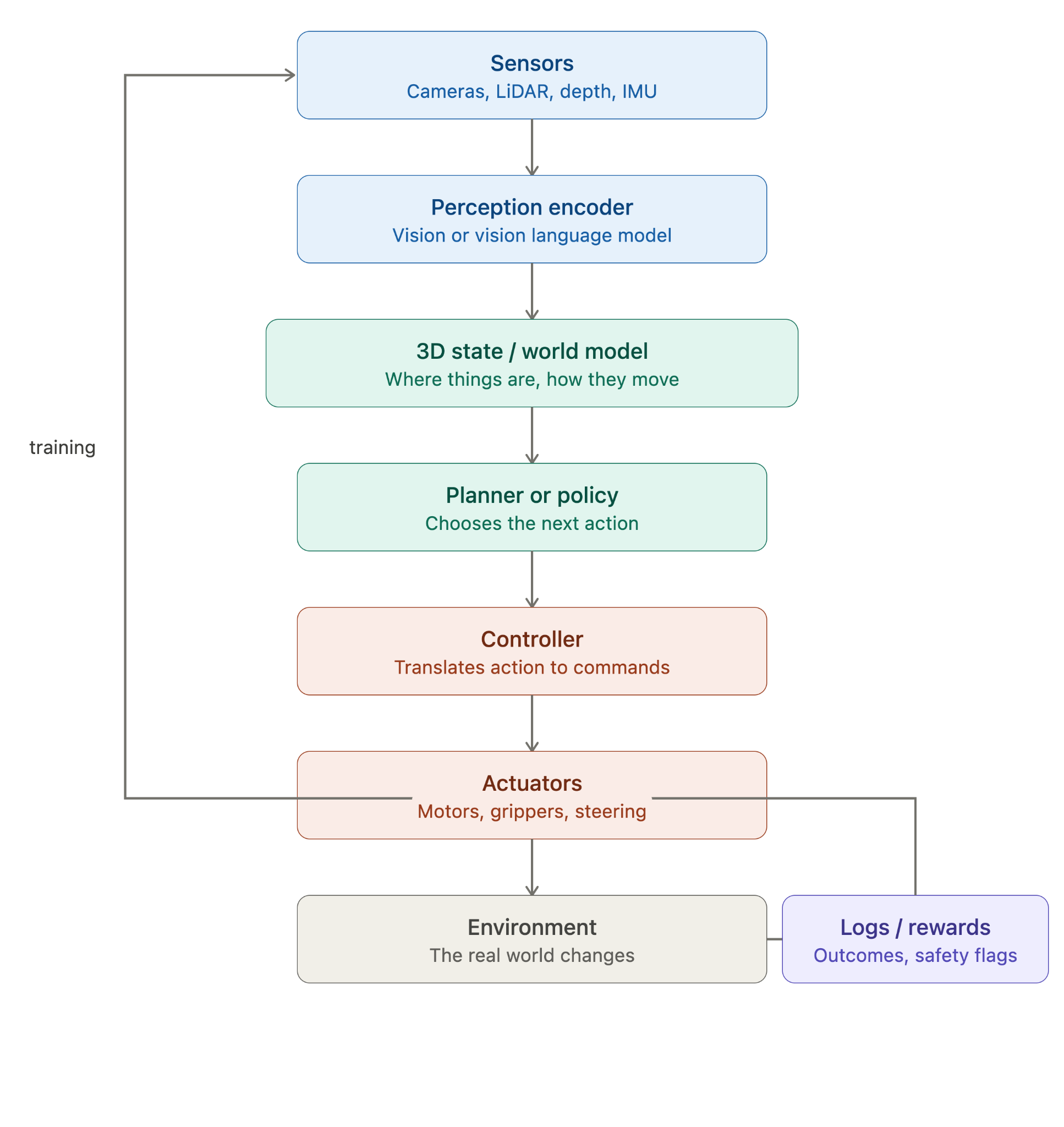
At runtime, the system is a feedback loop rather than a single inference call. Sensors produce observations; models estimate a useful state; a planner or policy selects an action; controllers execute it; and the resulting world state becomes the next training or evaluation signal. This loop is useful because it shows where the model sits inside the larger system.
A more concrete look at the same loop, as pseudocode for a closed-loop agent, looks something like this:
@op # for observability
while True:
observation = read_sensors()                                                   # cameras, LiDAR, depth, IMU
state = estimate_state(observation, prior_state)             # fuse into a usable representation
goal = infer_goal(state, task_context)                                   # what are we trying to do right now
action = policy(state, goal)                                                         # plan or select an action
command = controller(action, state)                                     # translate to actuator level commands
execute(command)                                                                       # send to motors, grippers, steering
outcome = read_sensors()                                                          # observe the result
reward, safety_flag = evaluate(outcome, goal)                 # did it work, was it safe
log(observation, state, action, command, outcome, reward, safety_flag, model_version)
prior_state = state
if training_mode:
update_policy_or_dataset(observation, state, action, reward)
Each piece of this loop maps to a real engineering component. Cameras, LiDAR, depth sensors, and IMUs handle the raw sensing layer. A perception encoder, which today is often a vision model or a vision language model, turns raw pixels and point clouds into something more structured. The 3D state or world model represents where things are, how they are moving, and what the system currently believes about the environment. A planner or policy, which might be a classical motion planner, a learned policy, or some hybrid, decides what to do next. The controller takes that decision and turns it into the low-level commands an actuator can actually execute, usually running on an edge runtime with hard real-time constraints.
Weights & Biases can help here by giving teams a system of record for experiments, datasets, models, reports, and evaluation results. When a robot fails in a specific aisle, or a camera model fails during a lighting change, the team needs to trace that failure back to the data, model version, configuration, and environment conditions that produced it.
Generative models become useful for physical systems when they are grounded in space, time, and action. A model that can describe an object is not enough. It must estimate where the object is, how it may move, what actions are feasible, and what could go wrong.
This is the gap between a model that is good at describing the world in language and one that is good at acting in it. A vision language model can tell you that there is a box on a shelf and that it looks heavy. It cannot, on its own, tell a robot arm exactly where to position its gripper, how much force to apply, or what will happen if the box shifts mid-lift. That requires grounding the model’s understanding in physical quantities: position, velocity, mass, contact forces, and time.
Physical AI systems typically combine several types of input at once. Images and video give visual context. Depth and LiDAR data give geometric structure. Text instructions let a human specify a task in natural language. Proprioception, meaning the robot’s own sense of its joint angles and limb positions, tells the system what it is currently doing. Force feedback tells it what is happening at the point of contact, which matters enormously for tasks like grasping or assembly.
Language and vision models help with the high-level reasoning. They are good at understanding instructions, recognizing object categories, and reasoning about task structure. But low-level control, the part where a gripper closes around an object with the right amount of force, still requires grounding, calibration, and validation against the physical system’s actual dynamics. A model can know conceptually that a glass is fragile. Translating that into the correct grip force on a specific actuator with a specific gripper is a separate engineering problem, and getting it wrong breaks things.
This broader idea, sometimes called generative physical AI, has been popularized in part by NVIDIA’s work on simulation and robotics platforms, though the concept itself is not tied to any single vendor. The core insight holds regardless of which tools you use: generative models become genuinely useful for physical systems only once they are tied to space, time, and the actual constraints of the hardware they are driving.
Physical AI has a data problem before it has a model problem. The system needs examples of what the world looks like, how objects move, how sensors behave, what safe actions look like, and what failure looks like. Real logs are the most valuable source because they come from actual robots, vehicles, cameras, or devices in the field. But real logs alone are rarely enough.
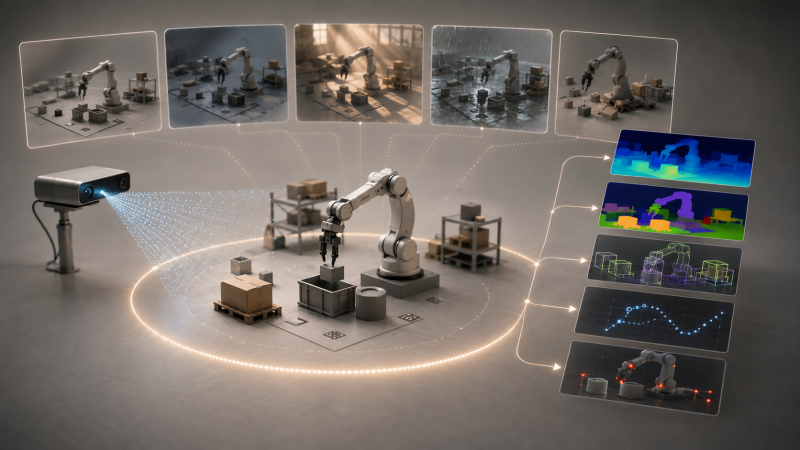
Collecting real-world data is slow because the system has to physically run through the task. A robot needs to pick, move, fail, recover, and repeat. A vehicle needs to drive through different roads, weather, lighting, and traffic patterns. A camera system needs to observe enough variation across shifts, layouts, and edge cases. Unlike text or clickstream data, you cannot simply generate more production traffic on demand.
The annotation problem is also harder. Physical AI datasets often need depth, pose, segmentation, trajectories, contact events, collision states, object metadata, and timing information. A simple category label is not enough when the model has to estimate where something is, how it is moving, and what action is safe.
Tools that show up frequently in this space include Omniverse Replicator for generating synthetic data with built-in ground truth labels, NVIDIA Omniverse as a simulation platform built around that format, Isaac Sim for robotics-specific simulation, and OpenUSD as a format for describing 3D scenes and assets in an interoperable way. These are examples of the kind of simulation and synthetic data infrastructure that has become common in this field, not the only tools available.
Reinforcement learning is another important tool for physical AI. In Reinforcement Learning, an agent learns by taking actions and receiving rewards. The reward signal indicates whether the agent is moving closer to the desired behavior. For physical systems, reinforcement learning is attractive because it can optimize behavior that is hard to label manually.
But reinforcement learning in the real world is difficult.
The AI agent may need many attempts. Some attempts may be unsafe. Rewards can be poorly designed. The learned behavior may exploit shortcuts in the simulator. A policy that looks successful in training may fail under small environmental changes. This is why many teams train reinforcement learning policies in simulation first. They can run many experiments faster, test dangerous scenarios safely, and gain a large amount of experience. Then they validate the policy in controlled real-world settings.
A practical physical AI workflow often combines imitation learning and reinforcement learning. The team may start with demonstrations, train a behavior-cloning policy, improve it in simulation using reinforcement learning, and then validate it on real hardware with strict safety controls.
Again, observability is critical. Teams need to track reward curves, policy versions, environment configs, simulation seeds, safety violations, action distributions, latency, and real-world performance.
That is where we can quickly see how Weights & Biases fits as the observability tool.

Physical AI is powerful, but it comes with hard engineering challenges.
Physical AI takes everything that already makes machine learning hard – noisy data, distribution shift, evaluation that never quite matches deployment – and adds a layer where mistakes have physical consequences and feedback comes from the real world instead of a held-out test set. The system loop of sensing, deciding, acting, and learning never really stops, which means the engineering discipline around data versioning, experiment tracking, and observability matters just as much here as it does in any other part of machine learning, arguably more.
For practitioners, the key idea is that physical AI is not just a model. It is a loop. Sensors observe the world. Models estimate state. Policies or planners choose actions. Controllers execute those actions. The environment changes. Logs and rewards serve as the next signals for training and evaluation.